region Choose your Region
Home / Aerospace Manufacturing Guides / The Aerospace Tier-2 Supplier Checklist: CNC Machine Requirements for Precision Aerospace Components in India (2026 Guide)

The Aerospace Tier-2 Supplier Checklist: CNC Machine Requirements for Precision Aerospace Components in India (2026 Guide)

India’s aerospace manufacturing industry is experiencing unprecedented growth, driven by increasing aircraft production, defense modernization programs, satellite manufacturing, and the Government of India’s Make in India initiative. As global aerospace companies expand their supplier networks, Indian manufacturers have a significant opportunity to become trusted Tier-2 suppliers by delivering precision-machined components that meet international quality standards.

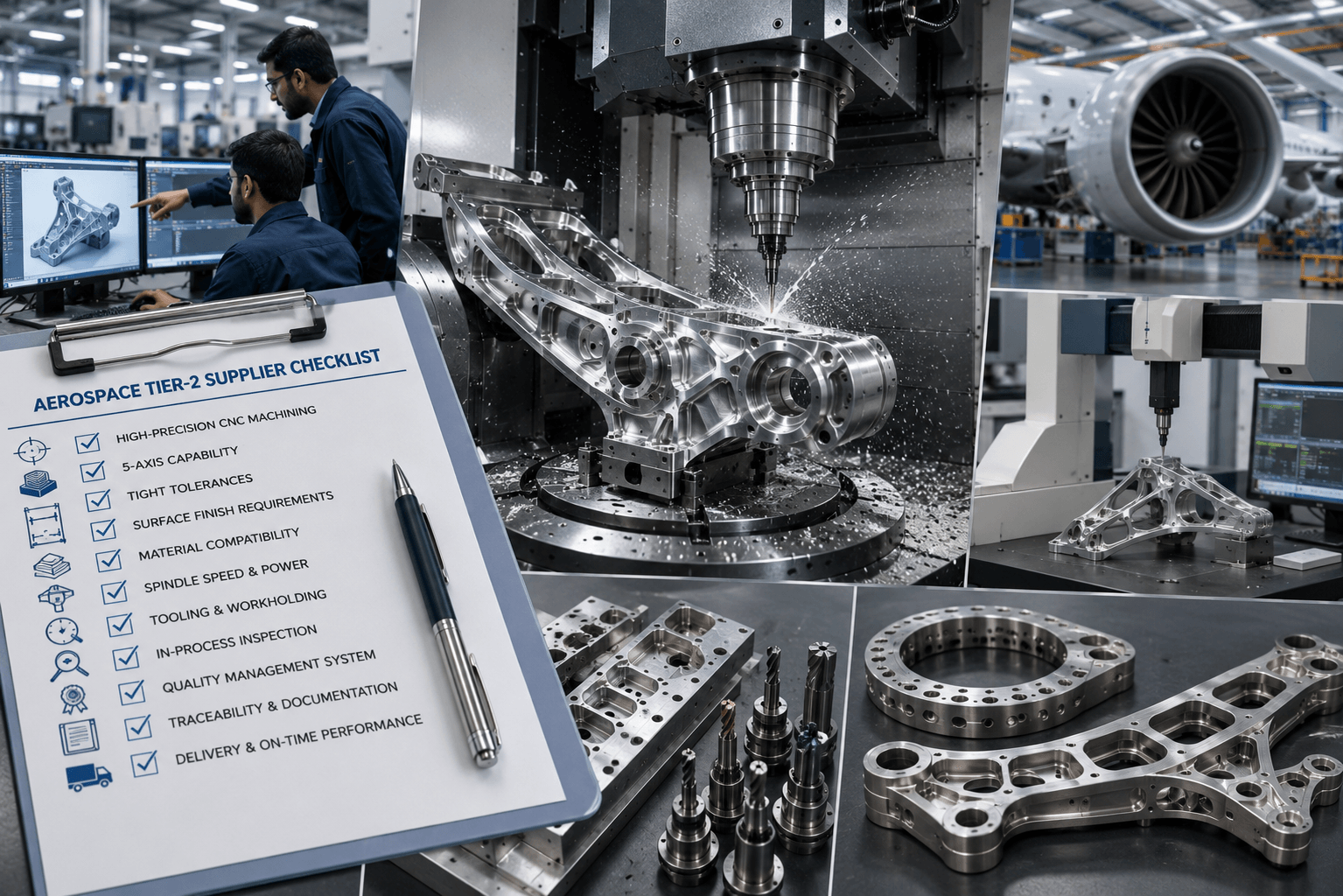
However, aerospace machining is far more demanding than conventional manufacturing. Components are often produced from difficult-to-machine materials such as titanium, Inconel, and aerospace-grade aluminum while requiring extremely tight tolerances, superior surface finishes, and complete process traceability. This guide explains the CNC machine capabilities, inspection requirements, and manufacturing practices that aerospace suppliers should evaluate before investing in new or used CNC equipment.
Key Takeaways

  • Aerospace machining demands exceptional accuracy, repeatability, and strict quality control.
  • 5-axis CNC machines significantly improve productivity by reducing multiple setups.
  • Titanium, Inconel, and aerospace-grade aluminum require specialized machining strategies and tooling.
  • Inspection methods such as CMM, GD&T, and First Article Inspection (FAI) are critical for aerospace compliance.
  • A high-quality used CNC machine can provide aerospace-level performance while reducing capital investment.

Why Aerospace Manufacturing Is Growing Rapidly in India

Today, Indian manufacturers are producing a wide range of aerospace components, including structural airframe parts, landing gear components, engine housings, turbine components, hydraulic systems, brackets, precision fasteners, and satellite hardware. As global OEMs continue expanding their supplier networks, Tier-2 and Tier-3 manufacturers have unprecedented opportunities to participate in international aerospace supply chains.

However, entering the aerospace sector requires much more than owning a CNC machine. Aerospace customers expect suppliers to maintain strict quality systems, documented manufacturing processes, complete material traceability, and exceptional machining accuracy. Every component must consistently meet demanding engineering specifications while maintaining repeatability across production batches.

Unlike general engineering industries where minor dimensional deviations may be acceptable, aerospace components directly influence aircraft safety, fuel efficiency, structural integrity, and long-term operational reliability. Even a small machining error can result in expensive scrap, production delays, or component rejection during inspection.

Major Growth Drivers in India’s Aerospace Industry

  • Expansion of commercial aircraft manufacturing
  • Growth in private defense manufacturing
  • Government support through Make in India initiatives
  • Increasing aircraft maintenance, repair, and overhaul (MRO) facilities
  • Growing exports of precision aerospace components
  • Demand for satellite and space technology manufacturing
  • Foreign investment in aerospace supply chains

For machine shops looking to diversify into higher-value industries, aerospace manufacturing represents one of the most attractive long-term opportunities. Investing in the right CNC equipment today can position manufacturers as trusted suppliers for domestic and international aerospace programs.

What Makes Aerospace Machining Different from General Manufacturing?

Aerospace machining is significantly more demanding than conventional CNC machining. Components must meet extremely tight tolerances while maintaining exceptional dimensional stability, superior surface finishes, and complete process consistency.

Many aerospace parts feature complex geometries, thin-wall structures, deep cavities, intricate pockets, and compound angles that cannot be produced efficiently using traditional machining methods. These requirements often make multi-axis machining essential.

Another major difference is documentation. Aerospace manufacturers require detailed inspection reports, machining records, material certifications, and traceability documentation for every production batch. Compliance with standards such as AS9100D and First Article Inspection (FAI) procedures is common throughout the industry.

As a result, CNC machines used in aerospace production must deliver exceptional rigidity, repeatability, thermal stability, and long-term reliability.

General Manufacturing vs Aerospace Manufacturing

FactorGeneral ManufacturingAerospace Manufacturing
TolerancesStandardExtremely Tight
Surface FinishModerateVery High Quality
InspectionBasic QCCMM + FAI + Documentation
Material TraceabilityLimitedMandatory
Machine AccuracyHighUltra High
Machine Type3-Axis / Turning4-Axis / 5-Axis / HMC

This combination of precision, documentation, and quality assurance explains why aerospace manufacturers invest heavily in advanced CNC technology and preventive maintenance programs.

Common Aerospace Materials and Their Machining Challenges

Aerospace components are manufactured using materials specifically selected for their strength-to-weight ratio, corrosion resistance, fatigue performance, and ability to operate under extreme temperatures. While these materials provide outstanding performance in service, they also present significant machining challenges.

1. Titanium Alloys

Titanium is widely used in aircraft structural components, landing gear, engine mounts, and airframe assemblies because of its exceptional strength and corrosion resistance.

However, titanium generates high cutting temperatures and has relatively poor thermal conductivity. Excessive heat can shorten tool life and increase machining costs if cutting parameters are not optimized.

Machining Challenges

  • High heat generation
  • Rapid tool wear
  • Lower cutting speeds
  • Excellent machine rigidity required

2. Inconel

Inconel is commonly used in jet engine components because it maintains strength even at extremely high operating temperatures.

Unfortunately, Inconel is one of the most difficult aerospace materials to machine. It rapidly work-hardens during cutting and places enormous stress on tooling.

Machining Challenges

  • Severe tool wear
  • High cutting forces
  • Requires rigid tooling
  • Excellent coolant delivery needed

3. Aerospace-Grade Aluminum

Aircraft manufacturers frequently use high-strength aluminum alloys for fuselage structures, wing components, battery enclosures, and interior assemblies because of their lightweight properties.

Although aluminum machines more easily than titanium or Inconel, maintaining excellent surface finishes and dimensional consistency remains essential.

Machining Advantages

  • High spindle speeds possible
  • Excellent productivity
  • Good surface finish
  • Reduced machine load

4. Stainless Steel & Specialty Alloys

Many aerospace hydraulic systems, fasteners, brackets, and structural components are manufactured using stainless steels and specialty alloys. These materials require stable machining conditions and consistent process control to achieve acceptable surface quality.

Essential CNC Machine Features for Aerospace Manufacturing

Choosing the right CNC machine is one of the most important decisions for aerospace suppliers. The equipment must consistently produce complex components while maintaining micron-level accuracy over extended production cycles.

1. Machine Rigidity

A rigid machine structure minimizes vibration, improves dimensional stability, and produces better surface finishes when machining difficult aerospace materials.

2. High-Speed Precision Spindle

Aerospace machining requires spindles capable of maintaining accuracy across varying cutting conditions while supporting both aluminum and difficult-to-machine alloys.

3. Thermal Stability

Thermal growth can affect machining accuracy during long production runs. Premium CNC machines incorporate thermal compensation systems to maintain consistent dimensions throughout the day.

4. Advanced CNC Controller

Modern controllers from FANUC, Siemens, Heidenhain, and Mazatrol improve toolpath accuracy, optimize machining strategies, and simplify complex multi-axis programming.

5. Automatic Tool Changer (ATC)

Aerospace components often require multiple cutting tools during a single machining cycle. Large-capacity ATCs reduce downtime and improve overall productivity.

6. Through-Spindle Coolant

High-pressure through-spindle coolant improves chip evacuation, extends tool life, and reduces cutting temperatures when machining titanium and Inconel.

7. Probe Systems

Integrated workpiece probing allows manufacturers to verify setup accuracy, reduce scrap, and improve first-pass yield during production.

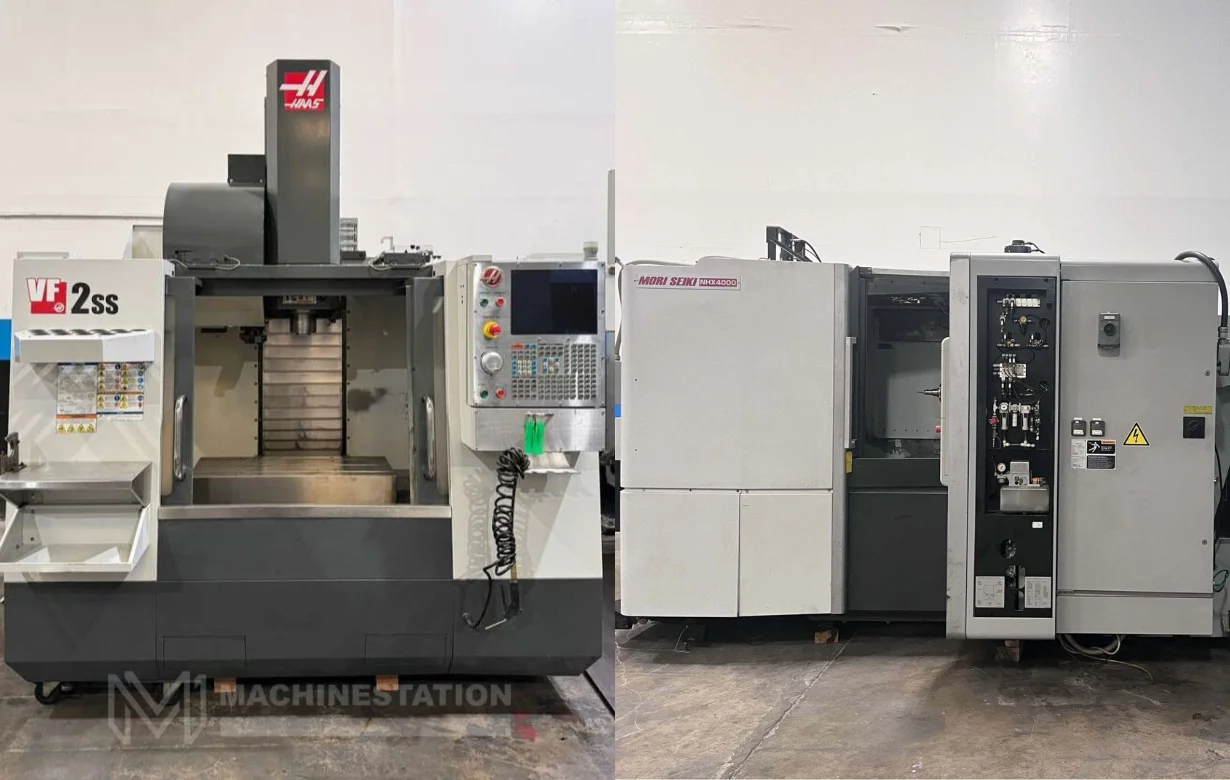
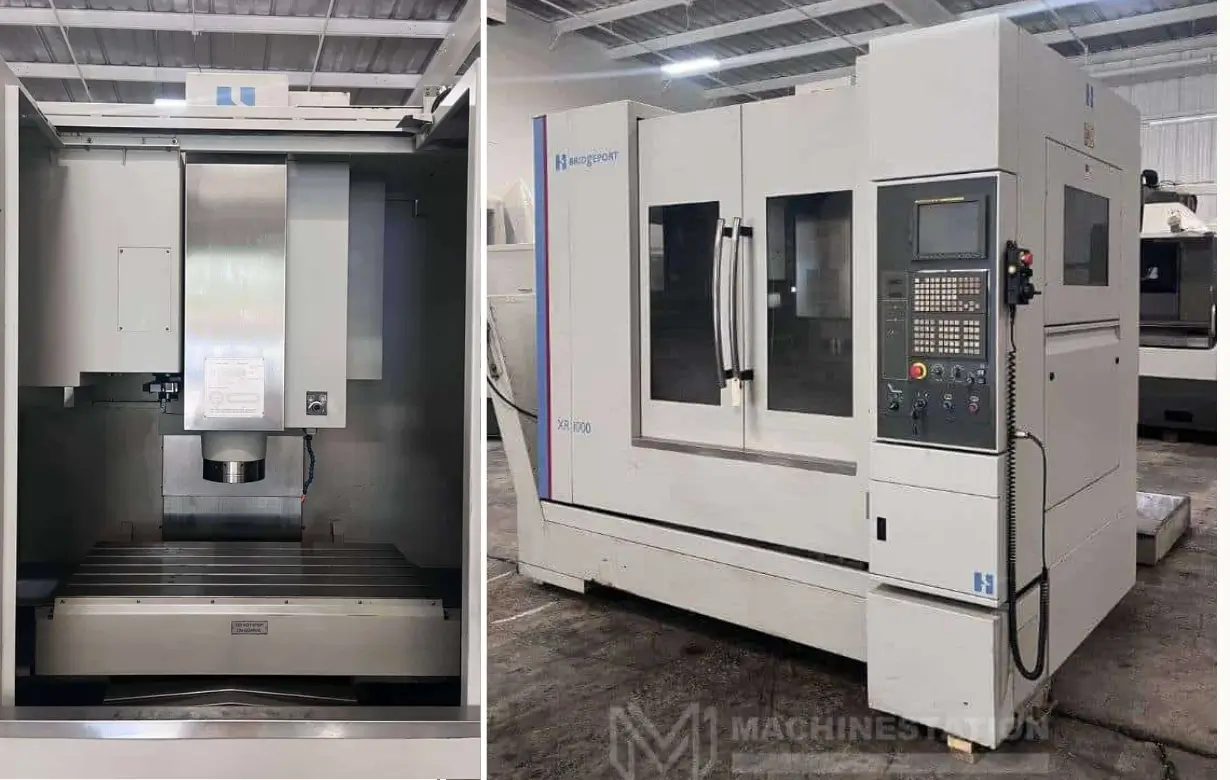
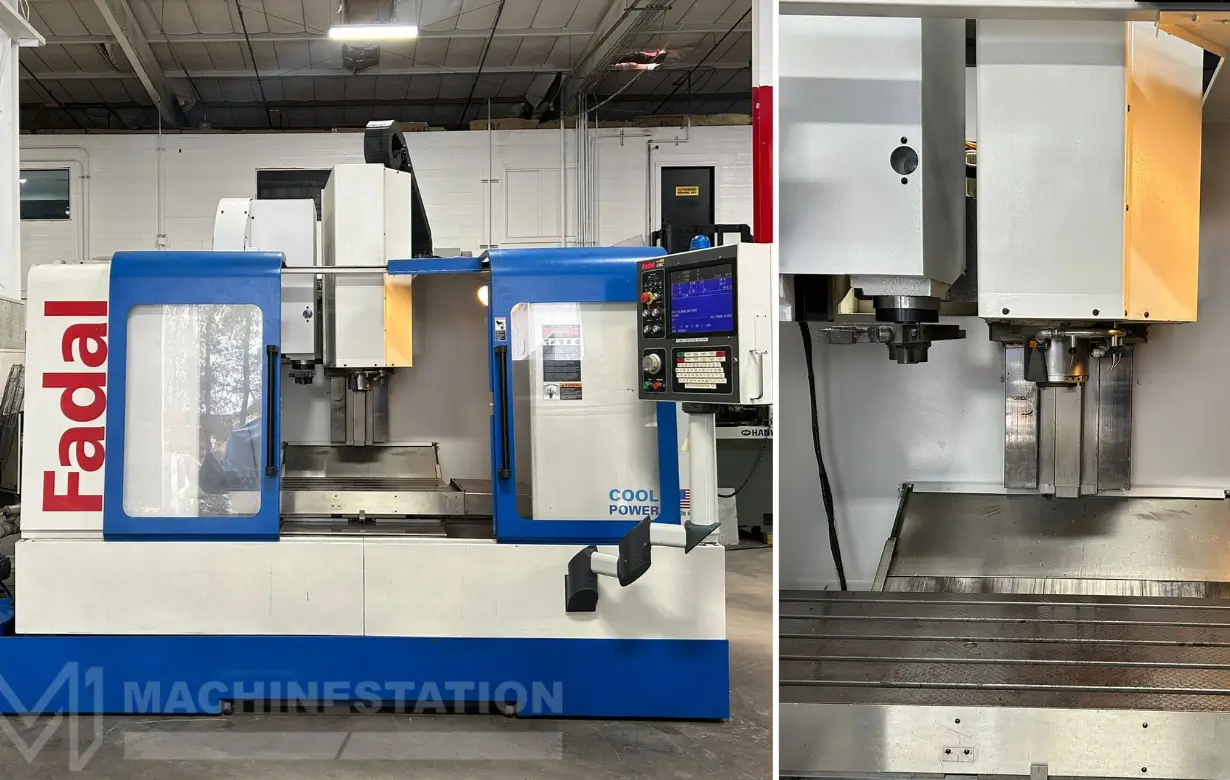
Manufacturers looking to upgrade their aerospace machining capabilities can explore premium Vertical Machining Centers, Horizontal Machining Centers, CNC Turning Centers, and Used CNC Machines available at MachineStation India.

Why 5-Axis CNC Machines Are Preferred for Aerospace Manufacturing

Modern aerospace components continue to become more complex as manufacturers strive to reduce aircraft weight while improving structural strength and overall performance. Components such as turbine blades, impellers, engine housings, structural brackets, landing gear parts, and wing attachments often feature intricate geometries that cannot be efficiently machined using conventional 3-axis equipment.

For this reason, 5-axis CNC machining centers have become the preferred solution across the aerospace industry. By allowing simultaneous movement along five different axes, these machines can machine multiple faces of a component in a single setup, reducing repositioning errors while significantly improving accuracy.

Reducing the number of setups also minimizes operator intervention, decreases production time, and improves consistency across large production batches. For aerospace suppliers working with expensive materials such as titanium and Inconel, reducing setup time can also lower the risk of part damage and material waste.

Key Benefits of 5-Axis CNC Machines

  • Machine complex geometries in fewer setups.
  • Improve dimensional accuracy and repeatability.
  • Reduce production cycle times.
  • Deliver superior surface finishes.
  • Increase spindle accessibility to difficult features.
  • Reduce fixture complexity and setup costs.
  • Improve overall productivity for aerospace components.

Although 5-axis machining centers require a higher initial investment, they often deliver substantial long-term savings through improved efficiency, reduced scrap rates, and shorter lead times.

Inspection, GD&T and Quality Control Requirements

Unlike many manufacturing industries, aerospace production is built around rigorous quality assurance processes. Every machined component must be verified before it can move to assembly, ensuring complete compliance with engineering drawings and customer specifications.

Inspection is not limited to measuring dimensions. Aerospace suppliers are expected to document every stage of production, verify machining accuracy, maintain calibration records, and provide complete traceability for materials and manufacturing processes.

Common Aerospace Inspection Methods

  • Coordinate Measuring Machine (CMM) Inspection
  • First Article Inspection (FAI)
  • Surface Finish Measurement
  • Digital Height Gauges
  • Laser Measurement Systems
  • Optical Inspection Systems
  • Tool Offset Verification

Geometric Dimensioning and Tolerancing (GD&T) is another essential requirement in aerospace manufacturing. Rather than measuring simple dimensions alone, GD&T controls form, orientation, profile, position, and runout to ensure every feature functions correctly during final aircraft assembly.

Manufacturers entering the aerospace sector should invest not only in advanced CNC machines but also in modern inspection equipment capable of validating complex components quickly and accurately.

How to Choose a Used CNC Machine for Aerospace Applications

Many aerospace suppliers successfully use premium used CNC machines to expand production capacity while controlling capital expenditure. A properly maintained used machine from a reputable manufacturer can often deliver performance comparable to a new machine at a significantly lower investment.

However, aerospace machining places higher demands on machine accuracy, spindle condition, thermal stability, and repeatability than most other industries. Therefore, purchasing decisions should always be based on technical evaluation rather than price alone.

Aerospace Machine Evaluation Checklist

  • Verify spindle condition and vibration levels.
  • Check ball screw backlash and axis repeatability.
  • Review machine maintenance records.
  • Inspect machine geometry and alignment.
  • Confirm controller software version.
  • Evaluate probing systems and tool measurement capabilities.
  • Inspect coolant filtration and chip evacuation systems.
  • Review machine operating hours.
  • Confirm availability of spare parts and service support.

Choosing machines from globally recognized manufacturers such as Haas, Mazak, Makino, Okuma, DMG MORI, Doosan, and Hermle provides better long-term support and higher resale value.

Browse premium Used CNC Machines, Vertical Machining Centers, and Horizontal Machining Centers to explore machines suitable for aerospace applications.

ROI Analysis for Aerospace Tier-2 Suppliers

Entering the aerospace industry requires investment, but it also provides access to one of the highest-value manufacturing sectors. Aerospace contracts typically involve precision components with higher margins than general engineering work, making advanced CNC equipment a strategic investment rather than simply a production expense.

Although aerospace projects demand higher quality standards, longer qualification periods, and more documentation, suppliers that consistently deliver precision components often benefit from long-term contracts and repeat business.

Investment AreaBusiness Impact
5-Axis CNC MachineHigher-value aerospace contracts
CMM InspectionImproved quality compliance
Premium ToolingLonger tool life & better finishes
Process DocumentationHigher customer confidence
Operator TrainingReduced scrap & downtime

For many manufacturers, purchasing a high-quality used CNC machine instead of a new one allows capital to be allocated toward inspection equipment, tooling, employee training, and process improvements—all of which contribute to stronger long-term profitability.

Common Mistakes Aerospace Manufacturers Should Avoid

1. Choosing Equipment Based Only on Price

The lowest-priced machine rarely delivers the precision and reliability required for aerospace production. Long-term productivity should always take priority over initial purchase cost.

2. Ignoring Machine Calibration

Regular calibration is essential for maintaining machining accuracy. Small positioning errors can lead to rejected aerospace components.

3. Underestimating Documentation Requirements

Many suppliers focus only on machining while overlooking documentation, traceability, and inspection reports that aerospace customers expect.

4. Using Inappropriate Tooling

Premium aerospace materials require high-performance cutting tools designed specifically for titanium, Inconel, and heat-resistant alloys.

5. Delaying Preventive Maintenance

Routine maintenance protects machine accuracy, extends equipment life, and minimizes unexpected downtime during production.

Looking for CNC Machines Suitable for Aerospace Manufacturing?

MachineStation India offers a wide range of premium used CNC machines, including Vertical Machining Centers (VMCs), Horizontal Machining Centers (HMCs), and CNC Turning Centers from globally recognized manufacturers.

If you’re planning to expand into aerospace or defense manufacturing, our team can help you identify the right machine based on your production requirements, material types, tolerance expectations, and budget. Contact MachineStation India today to discuss your application and receive expert guidance on selecting the ideal CNC solution.

Conclusion: 

The aerospace manufacturing industry demands far more than conventional machining capabilities. Precision, repeatability, traceability, and strict quality control are essential requirements for producing aircraft components that meet international safety and performance standards. Manufacturers looking to enter the aerospace supply chain must invest in CNC machines capable of consistently delivering micron-level accuracy while maintaining long-term reliability.

FAQs:

Which CNC machines are most commonly used for aerospace manufacturing?
5-axis machining centers, horizontal machining centers (HMCs), vertical machining centers (VMCs), and precision CNC turning centers are commonly used to manufacture aerospace components because they offer high accuracy, repeatability, and the ability to machine complex geometries.
5-axis CNC machines reduce multiple setups by machining complex parts from different angles in a single operation. This improves dimensional accuracy, surface finish, production speed, and overall machining efficiency.
Aerospace manufacturers frequently machine titanium alloys, Inconel, aerospace-grade aluminum, stainless steel, and other high-performance alloys because they provide excellent strength, corrosion resistance, and high-temperature performance.
Yes. A properly maintained and professionally inspected used CNC machine can deliver the precision and reliability required for many aerospace applications while significantly reducing capital investment compared to purchasing new equipment.
Product has been added to your cart